
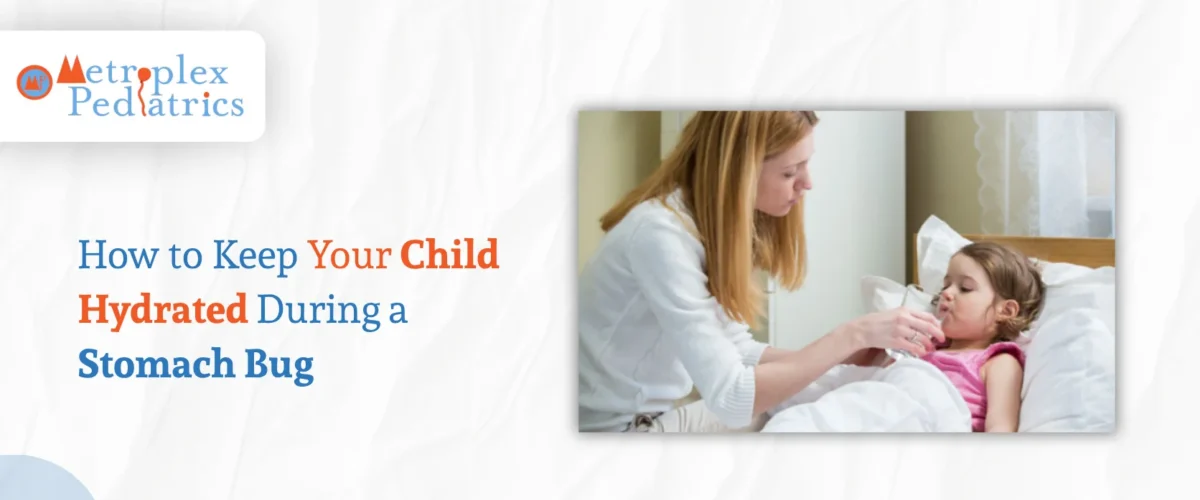
Learn how to keep your child hydrated during a stomach bug with practical tips for fluids, hydration, and recognizing signs of dehydration

How to Keep Your Child Hydrated During a Stomach Bug

It’s late at night, your kid just threw up for the third time, and you’re standing in the kitchen trying to remember if Pedialyte or water is the right call.
Stomach bugs are one of the most common reasons parents end up Googling at odd hours. The illness itself usually isn’t the scary part. Dehydration is.
Here’s the thing most parents don’t realize until they’re in the middle of it: kids get dehydrated a lot faster than adults do.
The highest priority during a stomach bug is ensuring fluids are administered and kept down. Keeping fluids down can sometimes be the hardest part.
Vomiting and diarrhea are terrible, but if fluids are kept down, progress is being made toward improving the situation.

Why Hydration Is the Real Priority During a Stomach Bug

Typical stomach bugs, also known as acute gastroenteritis, are usually viral and caused by bugs like norovirus or rotavirus.
Each case lasts anywhere from 1 to 7 days. There is no magic pill or drug to get the kids better quickly, so in the meantime, the best thing you can do is make sure they are getting plenty of fluids and helping their bodies to fight off the bug.
This isn’t just a comfort issue. Clinicians who treat kids with gastroenteritis treat dehydration risk as the main thing to watch for from the very first assessment, because untreated fluid loss can escalate quickly in small children. The good news: oral rehydration — just getting the right fluids in by mouth, in the right amounts — has cut child deaths from dehydration by half worldwide over the last few decades. That’s a low-tech fix with a huge track record.

Spotting Dehydration Before It Gets Serious

You don’t need a medical degree to catch this early. A few signs tend to show up before things get bad, and a few signs mean it’s time to stop waiting and get help.

Mild (Keep Managing at Home)Moderate to Severe (Call Your Doctor or Seek Care)
Slightly dry lips or mouthDry, sticky mouth with little to no saliva
Mild thirst, still playful between episodesLethargic, unusually irritable, or hard to wake
Normal or slightly reduced urinationFewer wet diapers or no urination for 6–8 hours
Tears present when cryingNo tears when crying
Skin bounces back normally when gently pinchedSkin stays tented or “doughy” when pinched
—Sunken eyes or a sunken soft spot (in babies under 18 months)
—Rapid breathing or unusually fast heartbeat

The three signs clinicians actually trust the most when checking a child for dehydration are an abnormal breathing pattern, how quickly the skin bounces back after a gentle pinch, and how long it takes for color to return to a fingernail bed after you press on it. If you’re ever unsure which column your child falls into, call your pediatrician’s office and describe exactly what you’re seeing. That’s what they’re there for.

The Best Fluids to Offer – and What to Skip

Not all liquids are created equal here, and this trips up a lot of well-meaning parents.

Offer ThisSkip This
Oral rehydration solution (Pedialyte, Enfalyte, or a store-brand equivalent)Apple juice and other sweet juices – they can actually make diarrhea worse
Breast milk, continued as normalSoda, sports drinks, and fruit punches – too much sugar, wrong electrolyte balance for a sick child
Small sips of water (fine for kids over 1, not a stand-alone fix for infants)Plain water alone for infants – it doesn’t have enough sodium for their needs
ORS popsicles for kids old enough for solidsBroths and teas – not enough of the right electrolytes

An oral rehydration solution has the right ratio of water, sugar, and salt for a sick kid’s body to actually absorb – that’s the whole point of it, and it’s why pediatricians reach for it over homemade mixes or sports drinks. One quick but important note: don’t water it down and don’t mix it into formula. Diluting it throws off the ratio that makes it work in the first place.

How Much, How Often: Keep It Small and Steady

This is the part that saves parents a lot of frustration. Big gulps tend to come right back up. Tiny, frequent sips tend to stay down.

  • During active vomiting: start with about a teaspoon (5 mL) of ORS every 5 to 10 minutes, even if that feels absurdly small. Use a spoon or oral syringe if your child won’t sip from a cup.
  • As vomiting slows down: gradually increase the amount, maybe an ounce every 30 to 60 minutes, as long as it’s staying down.
  • For diarrhea without much vomiting: offer fluids more freely, and aim for roughly double their usual fluid intake for the day.
  • Breastfed infants: keep nursing, just more often and in shorter stretches. Don’t stop breastfeeding to “rest the stomach” – that’s outdated advice.
  • Formula-fed infants: some doctors suggest alternating formula with ORS for the first 12 to 24 hours; others say stick with formula as tolerated. This is genuinely worth a quick call to your pediatrician, since it varies by age and how sick your baby is.

ORS shouldn’t be the only thing your child drinks for more than about 6 hours without a doctor weighing in — it’s meant to bridge the roughest stretch, not become the whole diet.

What About the BRAT Diet?

If you grew up hearing “bananas, rice, applesauce, toast” as the go-to sick-kid menu, here’s an update worth knowing: that advice has changed. The American Academy of Pediatrics no longer recommends the BRAT diet. It’s too low in protein, fat, and fiber to actually help a child’s gut recover, and some pediatricians think it may drag symptoms out longer rather than shortening them.
Current guidance points toward getting kids back to their normal, age-appropriate diet within about 24 hours of getting sick — a real mix of fruits, vegetables, protein, yogurt, and carbs, not just bland starches. If your child genuinely only wants toast and crackers for a day, that’s not a problem. Just don’t feel like you need to restrict them to it.

When to Call the Pediatrician vs. When to Head to the ER

Most stomach bugs resolve at home with nothing more than fluids and patience. But a few situations call for more than a wait-and-see approach.

Call your pediatrician if your child:

  • Is younger than 6 months old
  • Has diarrhea that’s severe or lasting more than a few days
  • Keeps vomiting and can’t hold anything down, including small sips
  • Is urinating noticeably less than usual
  • Has significant belly pain
  • Has diarrhea with blood or mucus in it

Head to the ER or call 911 if your child:

  • Seems unusually lethargic, limp, or difficult to wake
  • Has gone 8 or more hours without urinating
  • Has a sunken soft spot (infants) or sunken eyes
  • Is breathing rapidly or has a racing heartbeat
  • Shows pale, mottled, or cold skin
  • Has any signs of severe dehydration combined with confusion or unresponsiveness

When in doubt, it costs nothing to call. Pediatric offices field these calls constantly, and a quick phone triage can save you an unnecessary ER trip — or catch something that genuinely needs one.

A Few Things That Actually Help

  • Keep an oral syringe or small spoon on hand — it’s easier to control tiny sips than trying to get a toddler to sip from a cup
  • Offer ORS popsicles for kids over 1; they’re often easier to get down than liquid
  • Don’t force food during active vomiting — focus on fluids first, food follows once vomiting settles
  • Wash hands frequently and disinfect surfaces — most stomach bugs are highly contagious, and keeping siblings healthy matters too
  • Trust your gut. You know your child’s normal. If something feels off, that instinct is worth listening to

When You’re Not Sure, We’re Here

Stomach bugs are exhausting for everyone in the house, and it’s completely normal to feel unsure about what’s fine to ride out versus what needs a professional look. That’s exactly what your pediatrician’s office is for. If your child is showing any signs of dehydration, or you just want a second opinion before another sleepless night, the team at Metroplex Pediatrics is ready to help — reach out and let’s get your little one back to themselves.
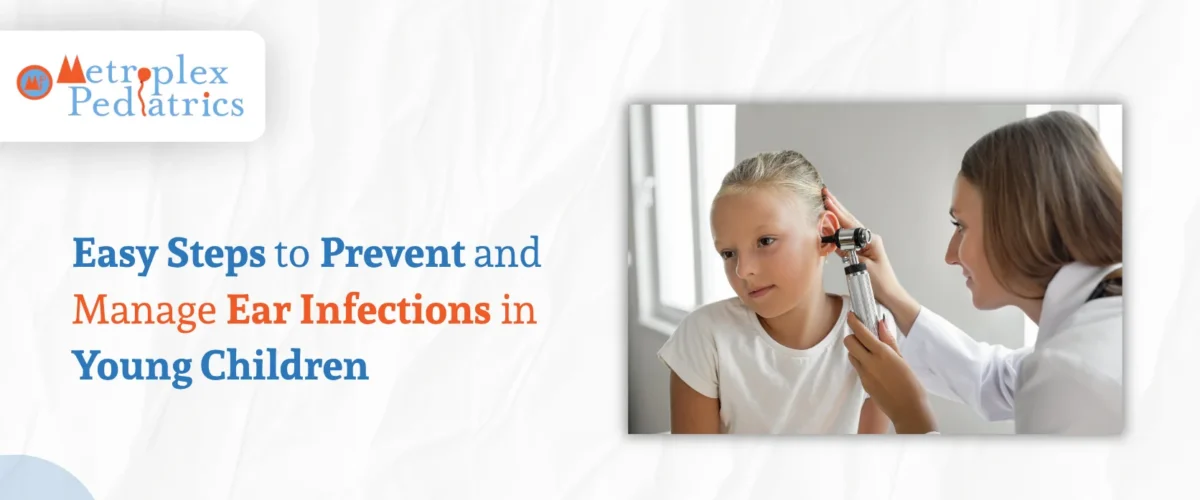
Easy Steps To Prevent And Manage Ear Infections In Young Children

Easy Steps To Prevent And Manage Ear Infections In Young Children

Ear infections are one of those things almost every parent runs into sooner or later. Most kids get at least one by the time they turn three, and honestly, a good number get several.
Doesn’t make the late night crying any easier, but there’s a decent amount known at this point about what actually helps and what’s mostly just something someone’s aunt said once.

Why This Happens So Much At This Age

Little kids have a eustachian tube that sits flatter and shorter than an adult’s. Doesn’t sound like much, but it makes it a lot easier for fluid to get stuck behind the eardrum, especially right after a cold.
That’s usually the pattern parents notice: runny nose, seems to be clearing up, then suddenly an ear infection shows up out of nowhere.
Most of what’s going on here is called acute otitis media, basically an infection in the middle ear.
It’s one of the top reasons kids end up at the pediatrician, and a lot of that just comes down to how their ears are still developing at this stage.

What Actually Helps Prevent It

Breastfeeding does more here than people usually think. Exclusive breastfeeding for six months has been shown to cut the risk by close to 40%, with the strongest effect showing up in those first couple years.
Vaccines help too. The pneumococcal vaccine and the yearly flu shot are both tied to fewer ear infections, mostly because a lot of these start after a cold or flu has already worn a kid’s defenses down.
Keeping smoke away from kids matters more than people expect. It shows up over and over in research as something that raises the odds.

Recognizing The Signs By Age

Age GroupCommon SignsWhat To Watch For
Infants (0–12 months)Tugging at the ear, fussy during feeding, trouble sleeping  Fever, seeming unusually out of it, fluid draining from the ear  
Toddlers (1–3 years)Ear tugging, irritability, balance issues  Fever, fluid draining from the ear  
Older kids (3+)  Says their ear hurts, sounds muffled to themPain past 2–3 days, changes in hearing  

Fluid draining from the ear looks worse than it usually is. That’s typically just a small tear in the eardrum, and it heals on its own once the infection clears.

What Treatment Actually Looks Like First

This part catches a lot of parents off guard. Antibiotics aren’t always step one anymore, and that’s not doctors being casual about it, it’s actually what the evidence supports now.
For kids over 2 years with mild symptoms, a lot of pediatricians will suggest watching things for a couple days before reaching for antibiotics. Most ear infections clear up on their own, and skipping antibiotics when they’re not needed avoids the side effects and the bigger-picture issue of resistance building up over time.
That doesn’t mean just waiting around, though. Pain relief still matters during that stretch, usually acetaminophen or ibuprofen at the right dose for their age, plus a plan to check back in if things haven’t gotten better in a couple days.

A Few Things Worth Clearing Up

Every ear infection needs antibiotics? Not really. A lot of them clear up fine without any, and current guidance backs watchful waiting for plenty of mild cases past 2 years.
Swimming causes ear infections? That’s usually a mix-up with swimmer’s ear, which is a whole different thing, an infection in the outer ear canal instead of the middle ear. They get lumped together a lot even though the treatment’s not the same.
And the infection itself isn’t contagious, even though whatever cold or bug led to it probably was.

A Short List Worth Keeping Around

Breastfeed exclusively for six months if you can. Keep vaccines current, especially the pneumococcal one and the yearly flu shot. Keep smoke away from your kid. Feed babies sitting up a bit rather than flat. Ease off the pacifier around six months. Wash hands often, since honestly most of this traces back to an ordinary cold.

When It’s Actually Time To Call

Call right away if there’s a high fever, your child seems unusually out of it, there’s fluid or pus coming from the ear, or they’re under six months old and showing any signs of this.
A regular appointment works fine for milder symptoms in an older kid who’s still eating, sleeping, and acting like themselves. Still worth getting checked, just not an emergency.
If it keeps happening, three or more times in six months, that’s a conversation worth having with your pediatrician. Sometimes that leads to seeing an ENT or talking through whether ear tubes make sense.

Bottom Line

A lot of this comes down to ordinary stuff: breastfeeding when you can, keeping vaccines up to date, keeping smoke away, paying attention to how your baby feeds.
None of it’s a guarantee your kid sails through childhood without a single ear infection, but it does cut down how often it happens.
If your child keeps getting these or you’re not sure what to do next, the team at Metroplex Pediatrics can help you figure out a plan that actually fits your kid.

Note – This article is only for general info and isn’t a substitute for personalized medical advice.

Talk with your child’s pediatrician about symptoms and treatment specific to your child.

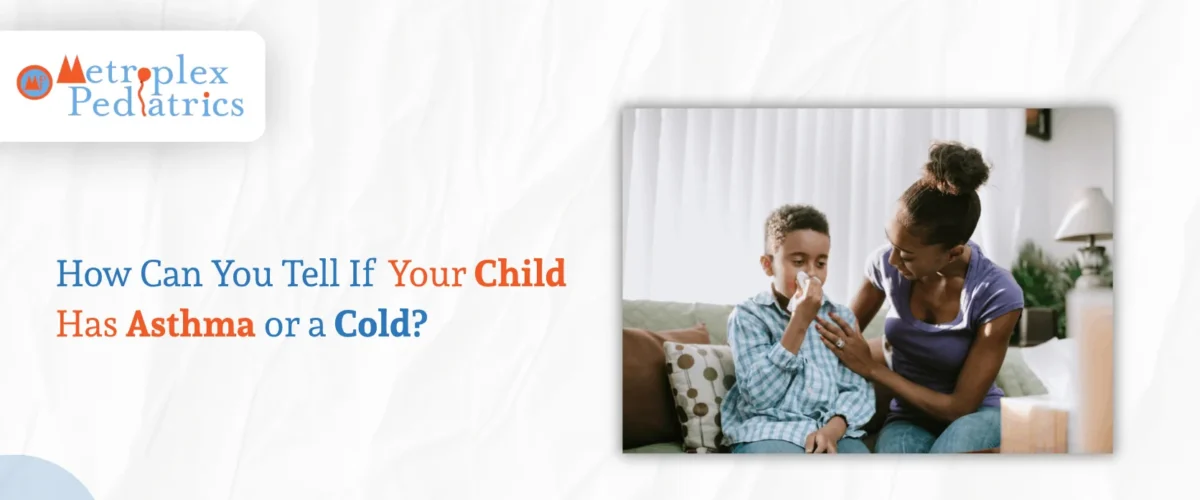
How Can You Tell If Your Child Has Asthma or a Cold?

How Can You Tell If Your Child Has Asthma or a Cold?

Your kid’s been coughing for a week straight. Cold running its course, or something with their breathing?
Even pediatricians don’t always sort this out in one visit, especially with younger kids who can’t put words to what they’re feeling. Still, there’s a pattern to look for.

Timing Tells You More Than the Cough Itself

A cold cough stays fairly level all day and night, maybe a touch worse once your kid lies down, but it doesn’t follow much of a rhythm.
Asthma does the opposite. It shows up or worsens at night and first thing in the morning, and it tends to spike after running around, in cold air, or with a virus, rather than sitting at one steady level.
The sound differs too. Asthma tends to sound dry, sometimes almost brassy. A cold cough is wetter, more of a rattle, since it’s mucus draining down from a stuffy nose rather than the airways themselves acting up.

The Company a Cough Keeps

Colds rarely travel alone. Stuffy nose, sore throat, a mild fever maybe, general low energy – all building over a day or two before peaking.
Asthma brings a different crew: a high pitched whistle on the exhale, tightness in the chest, a kid who stops talking mid sentence just to catch a breath. Little ones can’t usually explain any of it well. You’ll hear “my chest feels funny” more than an actual symptom report.

Duration Is Worth Tracking

A standard cold wraps up in about a week to ten days. If your kid seems to go from one cold straight into the next without ever fully clearing, or a cough drags on well past that window, pay attention to that. Virus triggered asthma can linger for weeks after the infection’s gone, since inflamed airways calm down a lot slower than the virus that stirred them up.

Why Young Kids Are the Hardest Case

There’s no dependable breathing test for kids under six. Spirometry, the test that measures airflow, requires a kid old enough to follow instructions and blow hard into a tube, which usually rules out anyone younger.
Add on top of that: little kids have naturally narrow airways, so toddlers wheeze with an ordinary virus fairly often without ever going on to develop asthma. One cough, runny nose, and fever during cold season is more likely just a bug going around. It’s the repeat episodes, wheezing and coughing showing up again and again, that shift the odds toward asthma.

Track It Instead of Guessing

Because the overlap is so messy, and symptoms have a habit of calming down right as you sit in the exam room, a home log helps more than people expect.
Write down:

  • When the cough hits
  • How long it lasts
  • What seems to set it off — exercise, cold air, a particular allergen

A quick video during an episode gives your pediatrician something to actually look at, not just a secondhand description.

What Points Toward Asthma

  • Coughing or wheezing that reliably worsens with exercise, cold air or a specific allergen
  • Symptoms that flare mostly at night or early morning
  • Episode after episode that looks like bronchitis, or a cold that never fully lifts
  • Asthma or allergies elsewhere in the family
  • Wheezing loud enough to hear without a stethoscope
  • Breathing trouble that keeps interrupting sleep or play

No single item here settles it. A few showing up together is enough reason to bring it to your pediatrician instead of waiting to see what happens.

When a Call Is Worth Making

Most mild colds only need rest and fluids. Call no matter how it started if you notice:

  • Wheezing or a whistle while breathing
  • Fast breathing, or the skin pulling in around the ribs or neck
  • A cough or breathing trouble that keeps disrupting sleep
  • Wheezing or coughing showing up with almost every cold
  • A kid skipping play because breathing feels uncomfortable

If you’ve landed in urgent care or the ER more than once for coughing or wheezing, that’s your cue for a closer look, maybe a referral to a pediatric pulmonologist or allergist.

What This Looks Like at Metroplex Pediatrics

Telling asthma apart from a stubborn cold takes more than running through a checklist, especially with younger kids where testing isn’t really an option yet. What you’ve noticed at home, combined with a thorough exam, gives your pediatrician the clearest shot at figuring out what’s actually happening.
If your child’s cough persists longer than a cold typically would or if it interferes with sleep and play – that’s probably a visit worth making. If you are confused about what is going on, Metroplex Pediatrics can help sort things out and get your child breathing better. Contact us to book a consultation.

How Often Should Your Child See a Pediatrician for Routine Exams?

How Often Should Your Child See a Pediatrician for Routine Exams?

This is a question new parents hear multiple times. Just how many times do we need to come back in.
The truth is more than most expect – especially in the early part of your journey.
After that first year, though, it settles into a rhythm most families can plan around.

The First Year Is the Busiest Stretch

Newborns change fast. Faster than at almost any other point in life, honestly.
This is exactly why the visit schedule in the beginning is so busy. Guidelines from the American Academy of Pediatrics are followed by most pediatricians.
That first year usually means checkups within the first few days of birth.
And again at 1 month, then at 2 months, then at 4 months, and again at 6 months and finally again 9 months later. That does feel a little too much but it is not.
A baby’s weight, length, and development can shift a lot from one month to the next! Catching something off track early usually means an easier fix later.
These visits also cover a big share of the vaccine schedule.  Spaced out on purpose, not crammed into one appointment.

The Toddler Years Start to Space Out

Once a child hits their first birthday, visits stretch a little further apart. But they don’t stop being frequent, not yet.
Expect checkups around 12 months, 15 months, 18 months, then 2 years and 2.5 years. A lot of developmental screening happens during this stretch.
Pediatricians are watching for things like walking, first words, how a toddler interacts with people around them.
If something looks like it needs a closer look, catching it at 18 months instead of age 3 makes a real difference.

After Age 3, It Becomes an Annual Rhythm

Somewhere around the third birthday, checkups shift to once a year. They generally stay that way straight through adolescence.
It sounds like a big jump from the toddler schedule. But growth has slowed down by this point and settled into something more predictable.
That doesn’t mean these yearly visits are just a formality. They still track growth, vision, hearing, and development. They’re also where a lot of routine vaccines get given on schedule.
For school-age kids, this visit often handles school and sports physical forms too.

Why Teens Still Need Yearly Visits

It’s easy to assume checkups matter less once a child gets older! Honestly, it’s kind of the opposite.
Adolescence brings its own things worth keeping an eye on.
Range of life events:

  • Growth spurts
  • Puberty
  • Preparing to enter sports
  • Mental health

Annual visits during the teen years give a pediatrician a private space to talk with a teenager one-on-one.
That matters more than people realize.
Stress, sleep, body image, mood — these are easier to bring up with a doctor who’s known the family for years.

When Extra Visits Make Sense

The routine schedule covers the basics. But it’s not the only time a child should see a pediatrician.
Ongoing conditions like asthma, allergies, or ADHD often need their own follow-up rhythm.
Separate from the standard yearly visit. Illness and injury visits are different too, obviously.
Those shouldn’t wait for the next scheduled checkup. A fever that won’t break. A rash that’s spreading. A change in behavior that feels off.
Any of that is worth a call, no matter where a child sits in the routine schedule.

What This Looks Like at Metroplex Pediatrics

Care at Metroplex Pediatrics begins on the very first visit with a newborn and continues through the teenage years.

The schedule is based around what really matters at each point.
The team, which is board-certified pediatricians, also makes sure every visit puts preventive care and early detection first.
Which is really the whole point behind that busy first-year schedule and the steady yearly checkups after.
Families in North Richland Hills and the surrounding Fort Worth area get a team that takes the time to actually know their kids.
Not just check boxes at each visit.
If it’s time to be back at a well-child exam, or if you’re unsure where your child can fit into the routine, Metroplex Pediatrics can help get you back on track!

What Parents Need to Know About Upper Respiratory Infections as Kids Head Back to School

What Parents Need to Know About Upper Respiratory Infections as Kids Head Back to School

That first school cough always shows up faster than you’d think.
Sometimes it’s the first week. Sometimes it’s day three. There’s an actual reason for that, and it’s worth knowing before your house turns into a tissue graveyard.

Why School and Cold Season Basically Run Together

Put a bunch of kids in one room with shared crayons, close desks, and questionable sneeze etiquette, and you’ve built a near perfect delivery system for viruses.
Infants in daycare catch something like 10 to 12 upper respiratory infections a year. Older kids average around 4, still more than most grown adults deal with.
None of that means something’s wrong with your kid. It just means a room full of developing immune systems, meeting viruses for the first time, spending all day in close contact, is going to produce a lot of runny noses. That’s the deal.

What’s Actually Going Around Right Now

A few different bugs tend to show up right as school starts, and current CDC data is worth a glance heading into this stretch of the year.
Rhinovirus and enterovirus activity usually climbs the moment the school year kicks off. These two are behind most of the ordinary colds working their way through classrooms every fall.
COVID-19 tends to pick up around the same window, though cases in kids are mostly mild at this point.
Flu and RSV generally stay quiet early on and ramp up more as fall shifts into winter. Worth watching, but rarely the thing hitting classrooms in September.

Sorting Out Which One You’re Dealing With

Symptoms blur together enough that guessing from the couch isn’t always reliable, but a few patterns give you a decent read.
A cold usually builds slowly. Runny nose, sneezing, a mild cough, maybe a low grade fever, and it tends to wrap up within a week or so.
Flu tends to come in fast and hit harder. Sudden fever, chills, aches, real exhaustion, often all at once instead of creeping up gradually.
RSV often looks just like a regular cold in older kids, but it deserves closer attention in infants and toddlers, where it can occasionally turn into something involving the lower airways.
If you’re genuinely unsure, calling your pediatrician instead of guessing is a completely reasonable move.
Testing for flu and RSV is available at most pediatric offices when it would actually change what you do next.

What Works

A handful of habits do most of the real work here, and repeating them at home helps even if school’s already drilling them in.
Washing hands, especially before eating and after coughing, sneezing, or using the bathroom, remains one of the most effective tools there is. Coughing or sneezing into an elbow instead of a hand cuts down a lot on what ends up on shared surfaces and supplies.
Keeping hands away from the face matters more than most people assume, since eyes, nose, and mouth are the easiest way in for these viruses.
Skipping shared water bottles and utensils sounds obvious, but it’s an easy thing to let slide on a rushed school morning.
Staying current on flu vaccines specifically remains one of the better tools for keeping illness milder, even when it doesn’t stop every single case.

When to Actually Keep a Sick Child Home

This is the part that stresses parents out constantly, especially with work schedules and school attendance rules pulling in opposite directions.

CDC guidance is fairly straightforward here. A kid can generally head back once symptoms are improving and they’ve gone at least 24 hours without a fever, without using fever reducing medicine to get there.
Some extra caution, handwashing, masking if your family prefers it makes sense for the five days after that, since contagiousness can hang around a bit past when symptoms ease up.
Sending a kid back too soon doesn’t just risk spreading it around the classroom. It usually means less time to actually recover – which can turn a short illness into a longer, messier one.

When a Call to the Pediatrician Actually Makes Sense

Most colds in kids run their course with nothing more than rest, fluids, and patience.
A few things are worth a call no matter how mild things looked going in.
Breathing that looks labored or difficult.

  • A fever that’s high, especially in a baby, or one that sticks around longer than a few days
  • Symptoms getting worse instead of better after several days have passed.
  • Unusual tiredness
  • Trouble keeping fluids down
  • A kid who just doesn’t seem like themselves in a way that’s hard to explain but easy to notice

Parents usually know their own kid well enough to catch that shift, and that gut feeling is worth trusting.

Related – The Essential Childhood Immunization Schedule Every Parent Needs

Getting Through the Season

Respiratory infections are pretty much unavoidable once the school year gets going, and that’s not a reflection of anything you’re doing wrong.
It’s just what happens when a lot of young immune systems spend their days together.
If you can help kids develop good habits at home, keep them up-to-date on vaccines, and know when a symptom is actually worth calling about and when it is just going to be fine despite the cough or two along the way (which seems pretty much a guarantee), I think that goes so far.
If your child’s symptoms aren’t clearing like you’d hope and you’re not sure what you’re looking at, visit us Metroplex Pediatrics today.

Contact us to learn more and book an appointment.

The Essential Childhood Immunization Schedule Every Parent Needs

The Essential Childhood Immunization Schedule Every Parent Needs

The first time most parents actually sit down and look at a vaccine schedule, it’s a lot.
Rows of ages, columns of dose numbers, abbreviations nobody bothers to explain. And you’re reading it half asleep, probably with a newborn on your shoulder.
So let’s walk through it in plain terms, age by age, based on what the CDC currently recommends for kids from birth through six.

Why So Much Happens in the First Two Years

Parents notice pretty quickly that the early stretch is the busiest by a wide margin. There’s a reason for that.
A newborn doesn’t have much natural immunity yet, and several of these diseases are at their most dangerous specifically during infancy. Whooping cough is a good example. In an older kid it’s miserable but survivable. In a baby under a year old, it can kill.
Spreading the doses out further wouldn’t buy anything except a longer stretch where a baby has no real protection at all.

Birth to 2 Months

Hepatitis B usually comes first, often within a day of birth. A second dose follows around one to two months.
By the 2 month visit, rotavirus, DTaP, Hib, and pneumococcal vaccines all start too. That appointment tends to involve several shots at once, and a lot of parents feel uneasy about that going in.
It’s actually well studied territory. Giving multiple vaccines in one visit doesn’t overload a baby’s immune system, and it cuts down on how many total appointments and pokes a child needs over time.
RSV protection sometimes comes up around this age as well, depending on the baby’s health and whether the mother got an RSV vaccine during pregnancy. Your pediatrician can tell you whether that applies to your particular child.

4 and 6 Months

The 4 month visit repeats second rounds of rotavirus, DTaP, Hib, pneumococcal, and polio.
At 6 months, third doses of several of those come due, plus the third Hepatitis B shot. The annual flu vaccine usually enters the picture here too, since it’s recommended starting at 6 months and repeated every year after.

Around 12 to 15 Months

Right around the first birthday, the lineup shifts to a different set of diseases entirely.
MMR, covering measles, mumps, and rubella, usually starts here as a first dose. Chickenpox and Hepatitis A doses tend to begin around now too.
They’re not given earlier because a baby’s immune response to these particular vaccines improves once maternal antibodies fade and the child is a little older. The timing isn’t random, it’s built around how the immune system actually develops.

15 to 18 Months Through Kindergarten

A fourth DTaP dose usually lands somewhere around 15 to 18 months, along with final Hib and pneumococcal doses.
Then between ages 4 and 6, right before most kids start kindergarten, a round of boosters locks in longer term protection. That typically means a fifth DTaP dose, a final polio dose, and second rounds of MMR and chickenpox.
Most states require proof of several of these specific shots before a child can enroll in school, so this stretch matters for paperwork as much as it does for health.

If a Child Falls Behind

Missing an appointment, or drifting a few weeks off schedule, doesn’t mean starting from zero.
Pediatricians use a catch up schedule built exactly for this. It accounts for the minimum spacing needed between doses so a child can still end up fully protected even on a delayed timeline.
The right move if your child’s fallen behind is talking to your pediatrician directly rather than trying to piece together a new schedule on your own. Every situation is a little different, especially if there’s an underlying health condition in the mix.

A Few Things Parents Ask a Lot

Whether it’s safe to get several shots at one visit comes up constantly, and yes, it is. This is one of the most heavily studied corners of pediatric medicine, and stacking vaccines in a single visit doesn’t weaken the response to any of them.
Side effects worry people too, understandably. Soreness at the injection site, a mild fever, some fussiness for a day, that’s all normal and expected. Serious reactions are genuinely rare, and pediatricians know exactly what to watch for and will talk you through anything that feels off.
Some parents ask whether the schedule shifts for kids with health conditions, and sometimes it does. Certain conditions change either the timing or which vaccines apply, which is exactly why this is worth a direct conversation with your pediatrician instead of relying on a general chart pulled from the internet.

Why the Timing Isn’t Just a Formality

Every age window on this schedule reflects when a specific disease is most dangerous and when a child’s immune system is actually ready to respond well to that vaccine.
Pushing things back without a real medical reason just stretches out the window where a child has less protection during exactly the stretch they’re most exposed to certain illnesses.
If you’re not sure where your child currently stands, or you’ve got questions about what’s coming up next, that’s worth bringing directly to your pediatrician rather than trying to sort out from a chart on a screen.

Metroplex Pediatrics can walk you through exactly where your child is on their schedule and answer whatever’s specific to your family. Reach out to book a well child visit.

Steps to ensure school readiness

American Academy of Pediatrics Urges Steps to Ensure School Readiness for All Children

Too many U.S. children start kindergarten without adequate social-emotional and behavior skills critical to school success, according to an American Academy of Pediatrics (AAP) report in the August 2019 Pediatrics. “School Readiness,” highlights rapidly expanding research that shows how these gaps can be eased or eliminated.

Key to this goal, according to the AAP, is providing developmentally sound and emotionally supportive early life experiences. These play a big role in how well a child learns to handle their feelings, relate to and communicate with others, and enter school ready to learn. Research shows that school success is tied to better social, economic, and health outcomes.

“In their relationships with families, pediatricians can help them establish the kinds of nurturing environments that promote school readiness,” said P. Gail Williams, MD, FAAP, a lead author of the technical report and an executive committee member of the AAP’s Council on Early Childhood.

“It’s not just about pre-academic skills,” Dr. Williams said. “It’s a combination of physical well-being, social emotional abilities, being able to self-regulate, as well as language skills and cognitive skills. And that starts right from birth.”

School readiness is largely determined by the health and well-being of children’s families and neighborhoods, as research increasingly shows. Consistent, developmentally sound and emotionally supportive early experiences help children more readily learn and develop resilience for life.

But while overall school readiness skills of young children have improved in recent years, gaps in achievement based on poverty, race, and early trauma remain.  For example:

  • Fewer than half (48%) of poor children are ready for school at 5 years of age, for example, as compared with 75% of children from moderate- or high-income households.
  • Children who have had two or more key traumatic events known as Adverse Childhood Experiences (ACEs)–such as abuse or neglect, witnessing violence in the home, or being separated from a parent due to death, incarceration or divorce–are 2.67 times more likely to repeat a grade in school than peers without adverse experiences.

Kindergarten screening, rather than a gatekeeping test for age-eligible children to enter school, should be a tool to guide planning, curriculum, and instruction to support developmental and academic achievement for diverse groups of children, according to the AAP.

“Because of societal inequities many children face, an emphasis on kindergarten readiness that only considers the skills of a child isn’t fair,” said Marc Alan Lerner, MD, FAAP, co-author of the report and member of the AAP’s Council on School Health. “Typical development in 4- and 5-year-old children normally varies a lot, so labeling children as not being ready for school at such an early age can isolate them from a more appropriate learning environment. Schools need to be ready to meet the needs of children at all levels of readiness.”

The technical report, which reinforces the 2016 AAP policy statement, “The Pediatrician’s Role in Optimizing School Readiness,” highlights how pediatricians can work with families to promote school readiness, which includes:

  • Helping families incorporate daily activities that strengthen language, cognitive skills and parent-child bonds, such as reading, storytelling, and playing games together.
  • Educating parents about normal child development and behavior and how to address behavior concerns in proactive, skills-building ways using positive discipline techniques.
  • Screening for psychosocial risks such as parental mental illness, substance abuse, family violence, and poverty and connect families with evidence-based community supports that can buffer the effects of “toxic stress” and reduce disparities in school readiness it causes.
  • Using developmental surveillance and screening to identify all children with developmental disabilities such as autism at an early age and connect families with early interventions that can have a positive impact in school readiness.
  • Advocating for expanded access to quality early childhood education to benefits individual children, as well as communities.

“Early experiences and support that occur as early as the womb, and then continuing with the support of loving homes and an absence of trauma, all help to build a brain that is ready to enter school,” Dr. Lerner said.  “By strengthening families, we are helping to encourage the kind of learning we would all like to see happen for all our country’s children.”

Additional Information from HealthyChildren.org:

COVID 19

Coronavirus Disease-2019 (COVID-19) and Children

Frequently Asked Questions and Answers

Q: What is the risk of my child becoming sick with COVID-19?

A: Based on available evidence, children do not appear to be at higher risk for COVID-19 than adults. While some children and infants have been sick with COVID-19, adults make up most of the known cases to date. You can learn more about who is most at risk for health problems if they have COVID-19 infection on CDC’s current Risk Assessment page.

Q: How can I protect my child from COVID-19 infection?

You can encourage your child to help stop the spread of COVID-19 by teaching them to do the same things everyone should do to stay healthy.

Clean hands often using soap and water or alcohol-based hand sanitizer
Avoid people who are sick (coughing and sneezing)
Clean and disinfect high-touch surfaces daily in household common areas (e.g. tables, hard-backed chairs, doorknobs, light switches, remotes, handles, desks, toilets, sinks)
Launder items including washable plush toys as appropriate in accordance with the manufacturer’s instructions. If possible, launder items using the warmest appropriate water setting for the items and dry items completely. Dirty laundry from an ill person can be washed with other people’s items.
You can find additional information on preventing COVID-19 at Prevention for 2019 Novel Coronavirus and at Preventing COVID-19 Spread in Communities. Additional information on how COVID-19 is spread is available at How COVID-19 Spreads.

Q: Are the symptoms of COVID-19 different in children than in adults?

A: No. The symptoms of COVID-19 are similar in children and adults. However, children with confirmed COVID-19 have generally presented with mild symptoms. Reported symptoms in children include cold-like symptoms, such as fever, runny nose, and cough. Vomiting and diarrhea have also been reported. It’s not known yet whether some children may be at higher risk for severe illness, for example, children with underlying medical conditions and special healthcare needs. There is much more to be learned about how the disease impacts children.

Q: Should children wear masks?

A: No. If your child is healthy, there is no need for them to wear a facemask. Only people who have symptoms of illness or who are providing care to those who are ill should wear masks.

Source CDC

Qtq80 238uUn landscape 7508f04e422827ccd4b6fdfad403503f j1s36v7ruad0 1200x500

Water Safety

Water Safety for Kids

Drowning is one of the leading causes of injury-related death in children, especially for toddlers and preschoolers. The good news is that drowning is preventable with the right safety steps in place.

1. Supervision Is the First and Most Important Layer

Drowning is often silent and fast. It does not usually involve splashing or yelling for help.

  • Always provide close, constant, and attentive supervision when children are in or around water.
  • For infants and toddlers, stay within arm’s reach.
  • Avoid distractions like phones, conversations, or alcohol.
  • Never rely on older children to supervise younger ones.

If you’re at a gathering, assign a specific “water watcher” so everyone knows who is responsible.

2. Install Barriers Around Pools

Most toddler drownings happen after unexpected, unsupervised access to water.

  • Use 4-sided fencing that completely separates the pool from the house and yard.
  • Gates should be self-closing and self-latching.
  • Use door alarms and locks if children have access to pool areas.
  • Pool covers and alarms do NOT replace fencing or supervision.

If visiting someone’s home, always check that safe barriers are in place.

Barriers Around Pools

3. Start Swim Lessons at the Right Time

The American Academy of Pediatrics supports swim lessons for many children starting after age 1, depending on developmental readiness.

Keep in mind:

  • Swim lessons reduce risk, but they do not “drown-proof” a child.
  • Swimming ability is just one part of “water competency.”
  • Supervision is still required, even if your child can swim.

Children should learn to:

  • Enter and exit water safely
  • Float or tread water
  • Turn around and move toward safety

4. Use Life Jackets — Not Floaties

  • Children should wear a properly fitted, Coast Guard–approved life jacket when boating or near open water.
  • Do not rely on water wings or inflatable toys—they are not safety devices.
  • Adults should model safe behavior and wear life jackets too.

5. Be Extra Careful in Natural Water

Lakes, rivers, and oceans have additional risks such as:

  • Currents and rip tides
  • Sudden drop-offs
  • Cold water
  • Limited visibility

Swim in areas with lifeguards when possible, and always follow posted safety signs.

Swim in areas with lifeguards

6. Learn CPR

Parents, caregivers, and older children should learn CPR. Immediate action can save a life while waiting for emergency responders.

Many community centers, hospitals, and Red Cross locations offer CPR classes.

7. Special Considerations

  • Children with autism are at increased risk of wandering and drowning.
  • Remove toys from pool areas when not in use to reduce temptation.
  • If your child is visiting a new location, always ask about water hazards.

Water Safety Is Layered Protection

No single strategy prevents all drownings. The safest approach combines:

  • Supervision
  • Barriers
  • Swim skills
  • Life jackets
  • CPR readiness

As summer approaches—or anytime your family is around water—take a moment to review your safety plan. Small steps can make a life-saving difference.

Stay safe and enjoy the water responsibly

CHECKLIST FOR DOCTOR'S VISIT

CHECKLIST FOR DOCTOR’S VISIT

Steps for patient

  • Parents and patients over 2 are required to wear face covering.
  • If possible, complete intake form prior to visit.
  • Only one family member per patient will be allowed in
  • Practice safe social distancing
  • Consider tele medicine for certain sick visits
  • If you think you have a medical emergency, please dial 911.

What to expect

  • Temperature check may be conducted before entry
  • Social distancing may be mandatory in waiting room
  • Telemedicine services may be offered, when appropriate.


Help Save Lives

#StopTheSpread